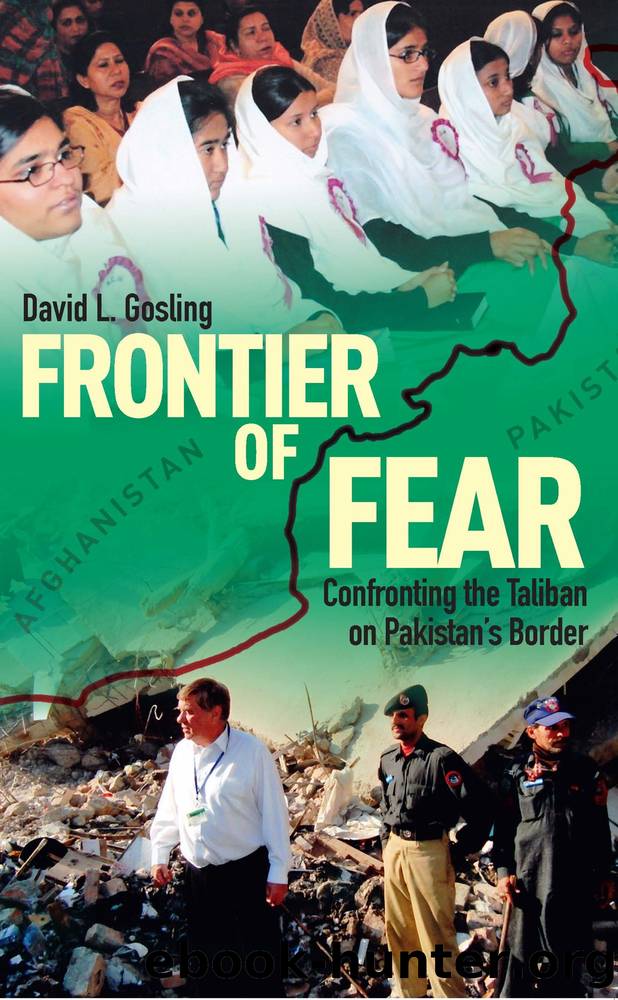
Frontier of Fear: Confronting the Taliban on Pakistan's Border by David L. Gosling
Author:David L. Gosling [Gosling, David L.]
Language: eng
Format: epub
Tags: Education, Political Science, Terrorism, General
ISBN: 9781784534684
Google: zKDWsgEACAAJ
Publisher: Bloomsbury Academic
Published: 2015-12-11T09:23:20+00:00
7
Educational Renaissance
One of the most severe critics of Pakistanâs higher education system is Pervez Hoodbhoy, Professor of Physics at Forman Christian College University, Lahore. In a trenchant article published in 2009 he writes:
Every country wants universities, and the more the better. There is a clear utilitarian goal behind this: universities have become the engines of progress for knowledge-driven economies in the age of rapid globalisation. They are the fountainheads of modern science, and of technologies that have changed the world more in the past fifty years than the previous 10,000 years.
But higher education requires much more than just building structures and calling them universities or colleges. There is little to be gained from a department of English where the departmentâs head cannot speak or write a grammatically correct non-trivial sentence of English; [â¦] a mathematics department where graduate students have problems with elementary surds and roots; or a biology department where evolution is thought to be new-fangled and quite unnecessary to teach as part of modern biology. Nor does putting a big signboard advertising a âcentre of excellenceâ make it one.
There are countless places in Pakistan where the above is not far from the truth. On the other hand, there are also some examples of high quality such as a world-class medical university and business schools, some good quality engineering and fine-arts colleges.1
Hoodbhoy traces the poor quality of many higher education institutions back to the period of British rule over the subcontinent:
In the early twentieth century, Muslims of the Indian subcontinent were, in general, poorly educated relative to Hindus. This was both because of British prejudice against Muslims, as well as resistance by orthodox Muslims to modern scientific ideas and to the English language.2
Historians may debate Hoodbhoyâs assertions about relationships between Muslims and the British â certainly they soured after the 1857 Sepoy uprising â but what concerns us here is how some Muslims adapted to science and Western education in general that was made possible by the decision in 1835 to make the English language the medium of instruction in higher education.
* * * * *
In the days of the undivided subcontinent in 1835, James Prinsep â head of the Calcutta mint and an able scholar â was so impressed by the standard of a class of chemistry students examined by him at the Calcutta Medical College that he wrote:
I do not think that in Europe any class of chemical pupils would be found capable of passing a better examination for the time they have attended lectures, nor indeed that an equal number [â¦] would be found so nearly on a par with their acquirements.3
The same year Thomas Babington Macaulay (1800â59), president of the Committee on Public Instruction, issued a Minute on behalf of the British legislature announcing that in future all higher education institutions in the subcontinent were to disseminate their knowledge through the medium of the English language. Many complex motives underlay this decision, but it enabled countless talented young people to prove themselves at least as capable as their peers in Europe.
Download
This site does not store any files on its server. We only index and link to content provided by other sites. Please contact the content providers to delete copyright contents if any and email us, we'll remove relevant links or contents immediately.
| Anthropology | Archaeology |
| Philosophy | Politics & Government |
| Social Sciences | Sociology |
| Women's Studies |
The Secret History by Donna Tartt(18993)
The Social Justice Warrior Handbook by Lisa De Pasquale(12175)
Thirteen Reasons Why by Jay Asher(8870)
This Is How You Lose Her by Junot Diaz(6854)
Weapons of Math Destruction by Cathy O'Neil(6243)
Zero to One by Peter Thiel(5759)
Beartown by Fredrik Backman(5706)
The Myth of the Strong Leader by Archie Brown(5479)
The Fire Next Time by James Baldwin(5407)
How Democracies Die by Steven Levitsky & Daniel Ziblatt(5196)
Promise Me, Dad by Joe Biden(5127)
Stone's Rules by Roger Stone(5065)
A Higher Loyalty: Truth, Lies, and Leadership by James Comey(4937)
100 Deadly Skills by Clint Emerson(4898)
Rise and Kill First by Ronen Bergman(4756)
Secrecy World by Jake Bernstein(4724)
The David Icke Guide to the Global Conspiracy (and how to end it) by David Icke(4676)
The Farm by Tom Rob Smith(4484)
The Doomsday Machine by Daniel Ellsberg(4471)
